

For the vast majority of my time in the hobby, I've focused entirely on sports, and in particular the big three of baseball, basketball and football. But over the past year I've gotten more interested in the massive TCG market. I've got kids who play a couple of the games, and that was my gateway to learning a bit more about them and coming to appreciate some of the artwork on the cards.
At the moment, cards of all types are seeing their markets explode, and TCG is no exception. In fact, many popular TCG's seem to be leading the way in terms of growth both in volume and sales.
I'm a data nut, so I decided to dig into eBay sales data for some popular card games as well as a few potential up and comers to see what I could learn about each market in terms of volume and supply/demand. Naturally, since I focus primarily on raw-to-grade, I focused specifically on the grading angle.
Everything below is based on data directly from eBay on the sale of PSA 10's for each different TCG. The data was collected August 4th.
Unsurprisingly, Pokemon is king when it comes to volume, but there's a lot more going on in the TCG market than Pokemon and that's where the interesting bits are.
Grading sales volume
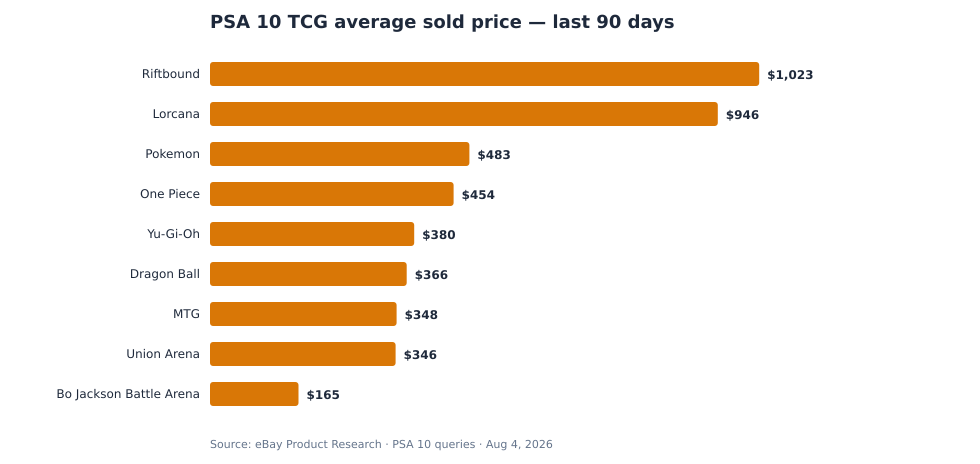
Dollar volume over the last 90 days based on PSA 10 sales (average sold price × total sold):
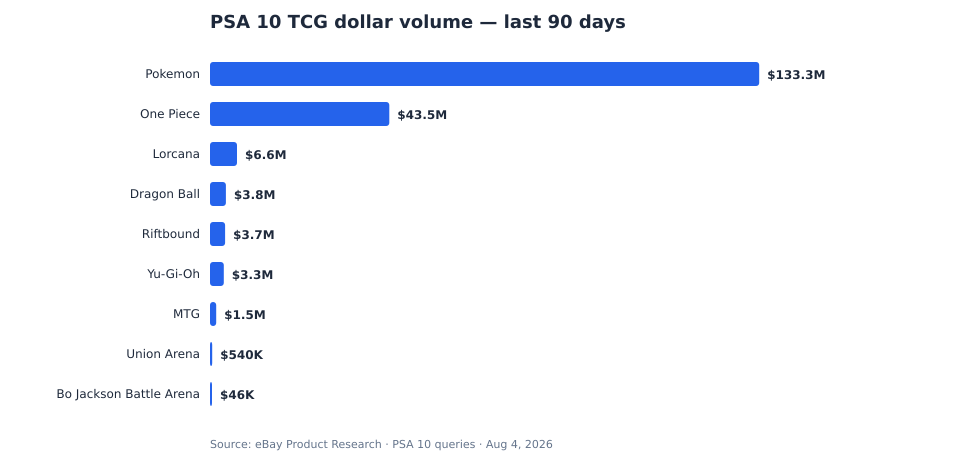
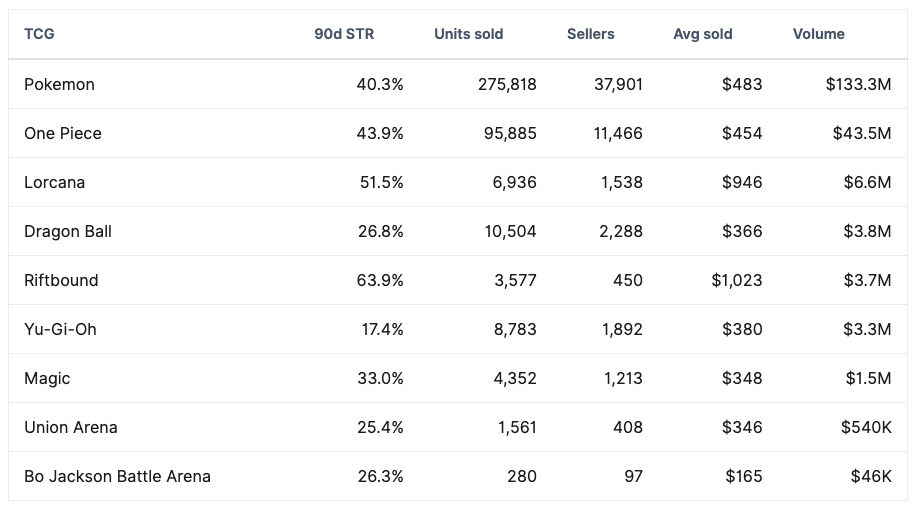
There's no real surprise here in terms of the three leaders. Everyone knows Pokemon is a massive, unparalleled market and the sales volume supports that with a massive lead in terms of cards sold, unique sellers and total sales dollars.
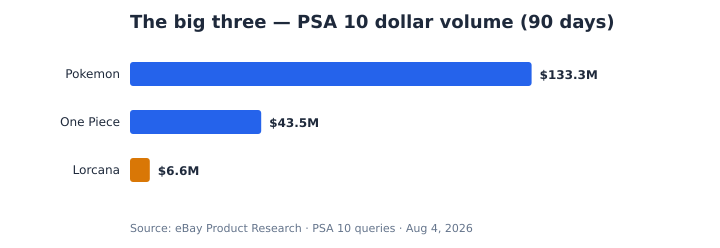
If you've been following along with the TCG market, the next two aren't particularly surprising either. One Piece has been taking off and Lorcana has been exploding this year (more on that particular game later). Even with the growing hype for both games, the gap between them and Pokemon in terms of total market is staggering. Lorcana in particular is clearly in its very earliest days of growth.
Yu-Gi-Oh, Magic the Gathering, and Dragon Ball are interesting in that they've been around for quite a while, but at least in terms of grading collectibility, none of those markets has really taken off the way One Piece or Lorcana have.
Dragon Ball and Yu-Gi-Oh actually have more total graded cards sold in the past 90 days than Lorcana and Riftbound, but at a much lower per slab price, and with much lower sell-through rates, keeping their overall volume much lower.
Union Arena and Bo Jackson Battle Arena are newer entries with a lot of room to go. Lorcana (2023) and Riftbound sit at the other end of the newer-TCG spectrum: smaller dollar markets than Pokemon or One Piece, but the strongest sell-through and per-slab prices on the board. More on that contrast below.
Lorcana and Riftbound: The Next Big Markets?
Lorcana is having itself a year and so is Riftbound. Both have a smaller amount of graded cards available and are in the early stages of grading taking off, and both are seeing some very large per-slab prices. Pokemon and One Piece have the large audience, but Riftbound and Lorcana have the underserved demand driving massive sales.
Lorcana does about $6.6M on only 6,900 units and 1,500 sellers with an average PSA 10 sale of $946. Graded cards also move very quickly. The 90-day sell through rate is 51.5%—much higher than Pokemon and One Piece.
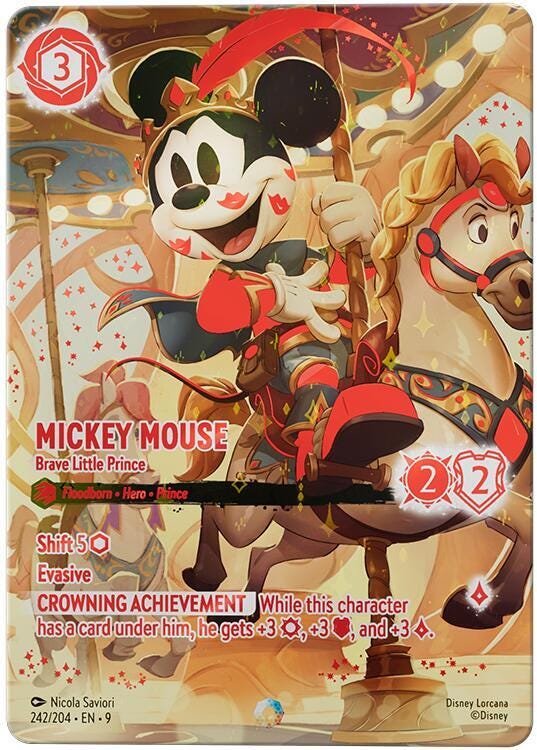
Part of that is the Disney IP. Disney has a massive fan-base and if you think about how much those fans spend on trips to theme-parks, cruises, movies, etc, it shouldn't be any surprise that they're not afraid to pay up for the cards they want. Lorcana also benefits from a very consolidated chase. There's 3-4 sets released each year (a small fraction of what we see in sports) and within those sets, for the most part the graded audience is sticking to Enchanted's and the newly introduced Iconics. Per set, there's only a few of each introduced so everyone is targeting the same few cards. So far, Lorcana has done a great job of protecting the scarcity of their chase cards. The result is a high premium on graded copies despite a very high gem rate.
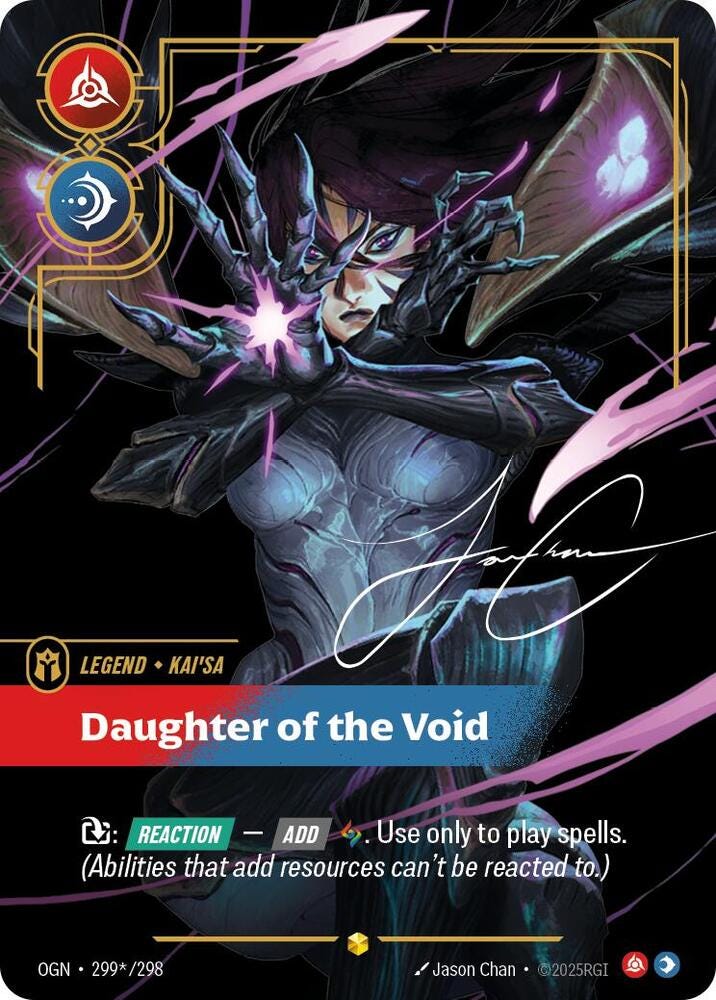
The only TCG with a better sell-through rate is Riftbound, and it actually shares a lot in common with Lorcana. Like Lorcana, Riftbound is based around an IP that has a big fan base and has been around for awhile (League of Legends is a massive online battle game first released in 2009). And once again the hits are pretty consolidated. Most of the graded dollars flow towards Signature cards (full-art) with a very low pull rate. The result is that we once again see everyone after the same few cards, and not enough grading supply to keep up with demand.
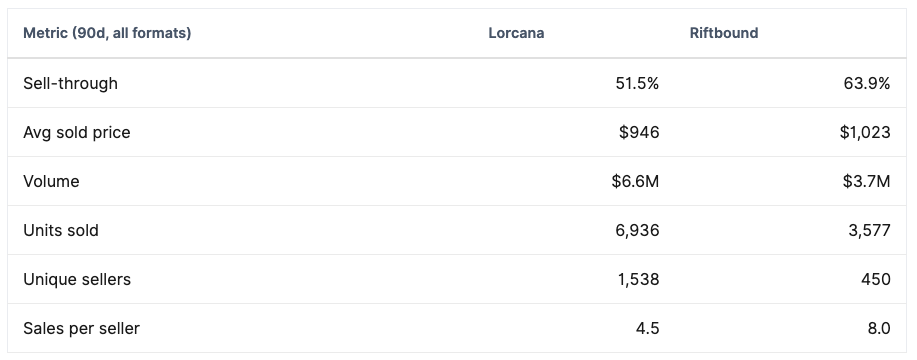
Same shape: scarce graded supply, expensive chase hits, strong clearance. Riftbound is younger and smaller in dollars. On sell-through and average price, it's ahead of Lorcana right now.
What about fixed price only?
Auctions inherently raise the sell-through rate as they are guaranteed to end within 10 days at most (on eBay at least). So I also ran the data for each TCG focusing only on fixed price and offer accepted listings to see if that changes the picture in any substantial way.
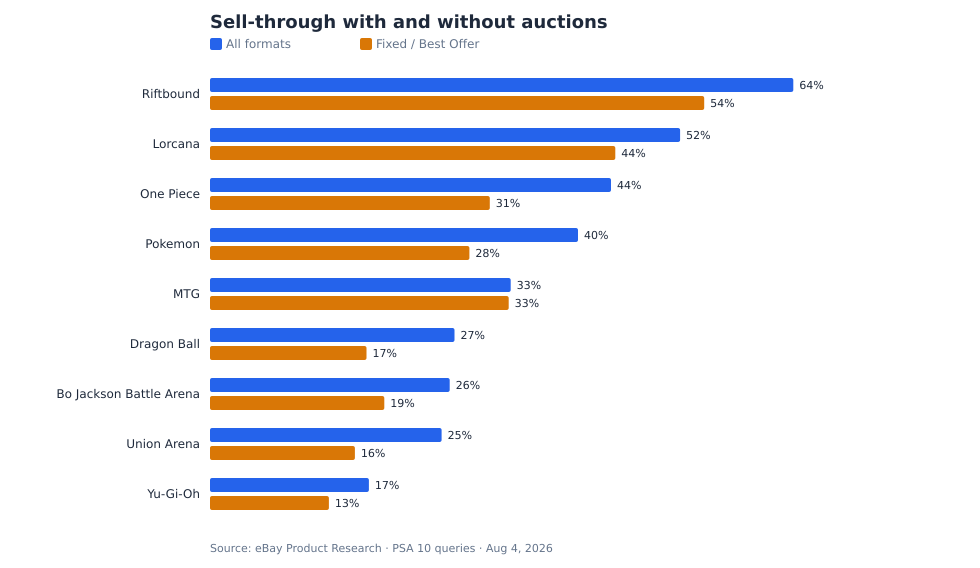
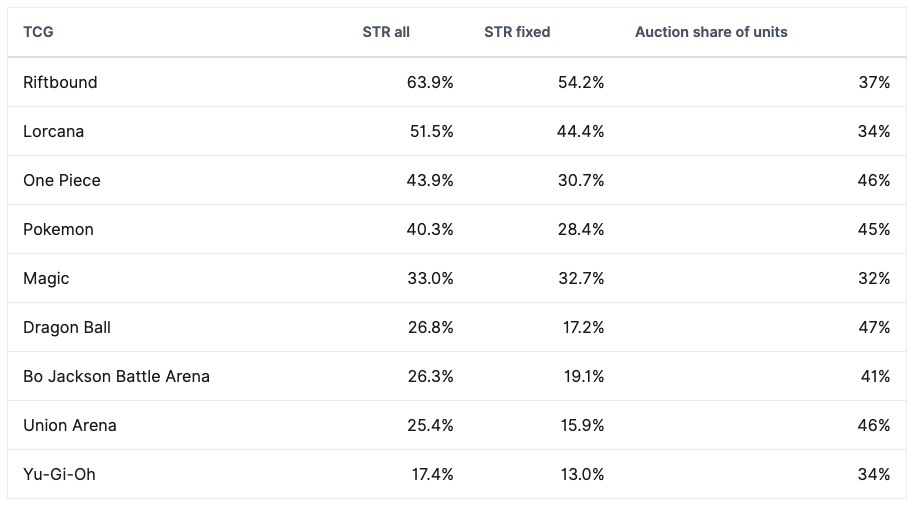
While the sell-through rates do drop, the order at the top does not: Riftbound, Lorcana, One Piece, Pokemon all continue to stay on top of the list. Lorcana and Riftbound are also more BIN-native than Pokemon and One Piece (roughly a third of units via auction vs ~45%). Magic barely moves (33.0% → 32.7%)—not a lot of auctions there. Dragon Ball loses nearly 10 points without auctions (27% → 17%)—almost half its units clear that way.
Sell-through isn't the only thing that shifts when you strip out auctions. Average sold price does too and from a selling perspective, that might be the more useful cut.
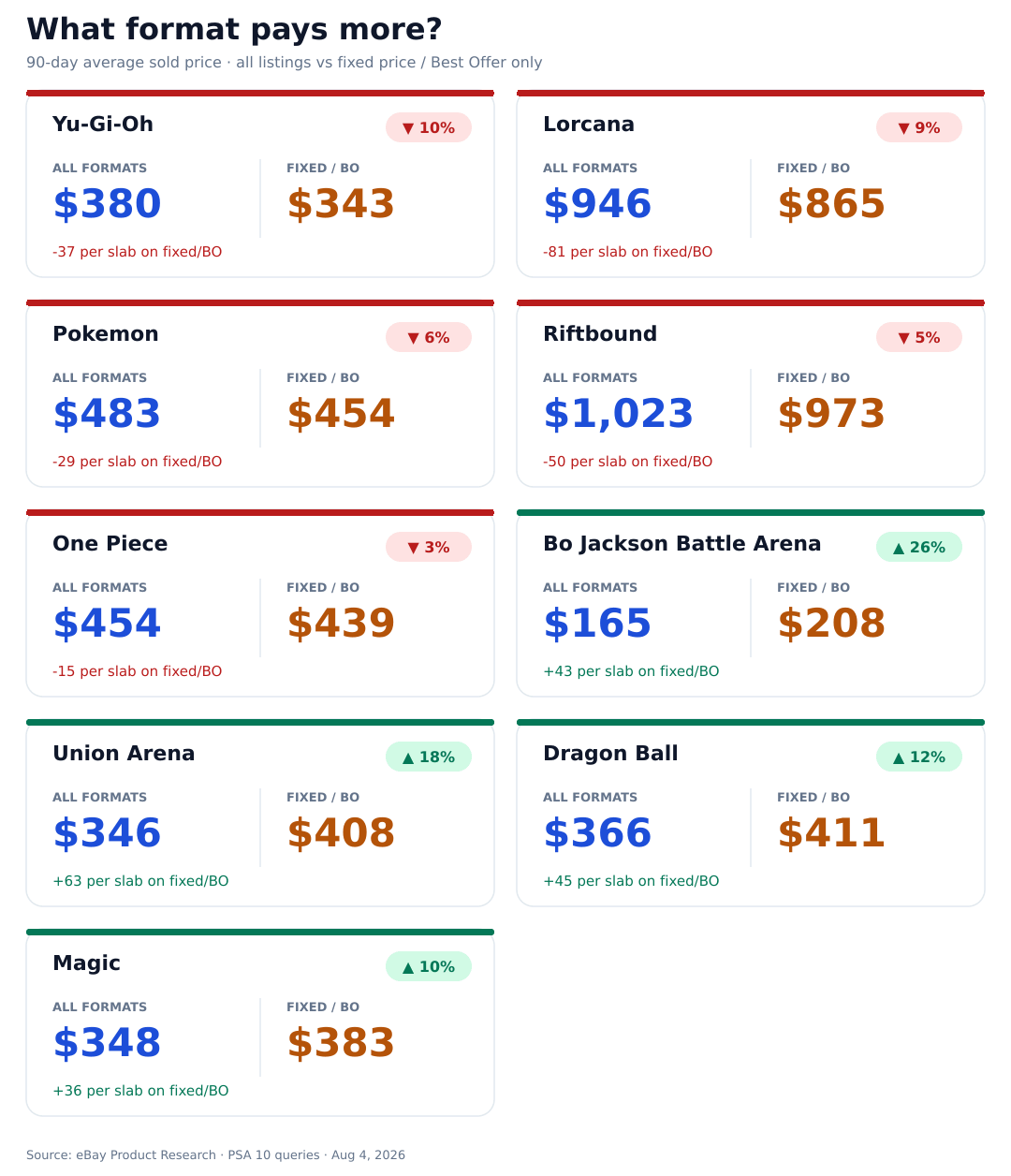
The board splits cleanly into two camps.
In Pokemon, One Piece, Lorcana, Riftbound, and Yu-Gi-Oh, the fixed / Best Offer average is lower than the all-formats average. Auctions are pulling the blended price up meaning the more expensive stuff is clearing through auction more often than through an ask. This is typically a sign of a rising market—when a market is on the rise auctions are often what sets new highs; when a market is declining auctions often set new lows.
In Dragon Ball, Magic, Union Arena, and Bo Jackson Battle Arena, it flips. Fixed / Best Offer averages are higher. Auctions are clearing cheaper and dragging the overall average down. In those markets, BIN / Best Offer is where the better comps live and dumping a slab into a short auction is more likely to leave money on the table. This makes sense for the four TCG's we see here: Bo Jackson Battle Arena and Union Arena are still so small in terms of audience size, and Dragon Ball and Magic the Gathering have pretty low sell-through rates which again is an indication demand isn't quite where you want it to be at in order for auctions to be the viable route.
Practical takeaway: don't just check "what's the average PSA 10." Check how those averages were made. Format mix changes what a good ask looks like.
The "other" TCG's
We've given a lot of attention to the top markets—Pokemon, One Piece, Lorcana and Riftbound—but now let's focus in on the "others" a bit.
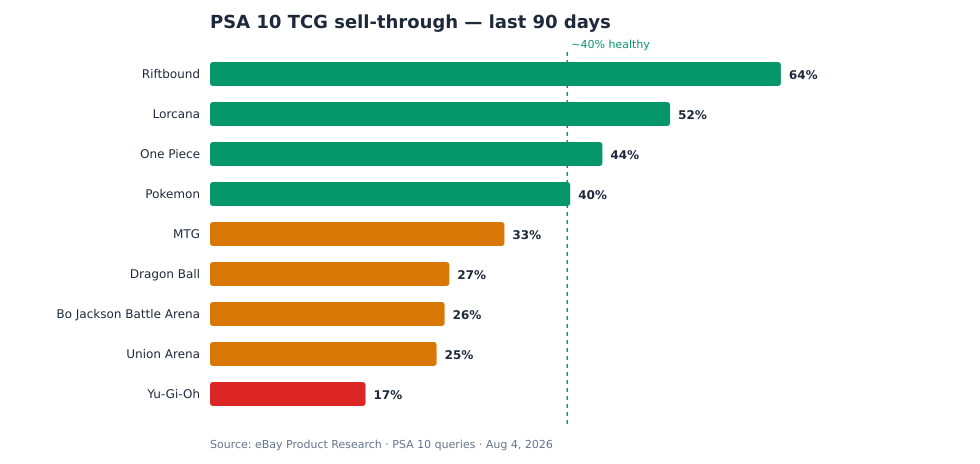
There's a clear drop-off after the top 4 when it comes to sell-through rate—graded cards just sit longer for the rest. They fall into a couple of different camps, though.
Magic the Gathering has been around since 1993, Yu-Gi-Oh cards since 1996, and Dragon Ball cards since 2000. None of these are new TCG's, but to date we just haven't really seen them catch on with the grading audience.
Longevity gets you brand recognition. It does not automatically get you a liquid PSA 10 secondary market. YGO is still the clearest case of volume without liquidity. Dragon Ball has more dollars moving, but just not enough clearance to feel hot.
Newer TCG's
The other camp is the newer TCG's. Union Arena was introduced in 2023, Bo Jackson Battle Arena in 2024, and Riftbound in 2025. We've covered Lorcana a lot already, but since that too was introduced in 2023 we'll include it here as I think, paired with Riftbound, it provides an interesting contrast. On a hobby timeline, all four are still young graded markets and they do not look anything alike.
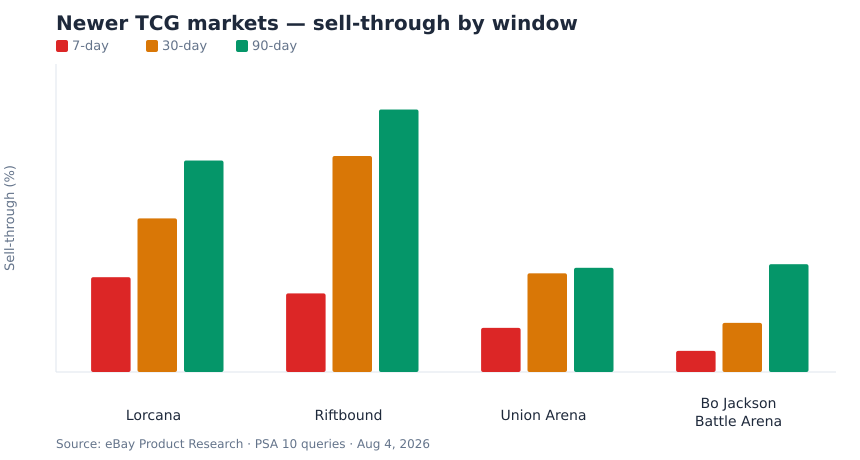
Lorcana and Riftbound are the massive success cases. We've already covered the mechanics above— consolidated chase hits, big IP fans who will pay, thin graded supply—but put next to the other young games, the gap is stark. Lorcana clears 52% over 90 days at a $946 average. Riftbound clears 64% at $1,023. Both move real dollars on relatively tiny seller counts.
Despite releasing the same year as Lorcana and a couple years before Riftbound, Union Arena has a much quieter market so far. There are a few reasons why that might be the case. Union Arena releases sets based on different Anime IP's. But those different releases cannot be played together in a single deck. That's great for new players who can just jump on the release or two they care about, but for the grading market it means the IP is a bit fragmented. Chases are also not quite as consolidated. There are serialized cards, and the non-serialized are fairly easy to come by.
Bo Jackson is also very young and while the market at the moment looks pretty unexciting, it is worth noting it's only been out a couple of years and there are certainly some signs that there's a growing demand: boxes struggle to stay in stock, and the marketing team has done a great job of promoting the release (as evidenced by long lines at this year's National conference).
What I'd actually do with this
If you're grading TCGs for resale (or any cards, actually), treat sell-through as seriously as comps. A $1,000 average means nothing if the listing sits for three months.
Pokemon and One Piece are the deep, liquid ponds and fairly safe as long as you're not chasing that new-release hype cycle. They're liquid with a big enough buyer pool to keep the cards moving.
Lorcana and Riftbound are the expensive, thinner markets where the upside is in the hits and growth seems fairly inevitable. Some of the sales seem almost silly in numbers and it wouldn't be surprising to see some price consolidation as more graded copies hit the market, but if you're in the mood to speculate, these do feel like the ones to dip your toes into and they're the ones I'm most interested in. I personally never advise holding in hopes things go up so I'll refrain from suggesting you do that, but I would be very confident buying raw singles to grade and sell.
Magic the Gathering, Yu-Gi-Oh and Dragon Ball are stable markets that have been around for awhile, but the demand for graded cards just isn't particularly high. They're much more player-based at the moment than collector based. Unless that's your passion or you've got the audience built up somewhere, it's hard to advise going too deep here.
Bo Jackson Battle Arena and Union Arena are too early to call. Both suffer a bit from a diluted pool of chase cards, and in the case of Bo Jackson Battle Arena, their characters being based on athletes means many are going to label these as "unlicensed" which is always a challenge. You can probably stockpile some raw cards cheap if you feel particularly confident in one or the other, in hopes that they go up and are worth grading at some point, but the risk here is certainly a lot higher.
I like this angle. Grading talk gets anecdotal very quickly, so looking at sell through rates and actual sales volume feels much more useful than just chasing headline prices. Curious whether TCGs end up behaving like sports cards long term, or develop their own market rules.