

When I first started selling cards, my focus was on maximizing the value of each card rather than quickly turning a card over. I would rather hold a card to be able to get a little bit extra profit than move it quickly for less. It was certainly much more satisfying on a per-card basis because you see those much larger profit margins and ROIs, but it did mean that sometimes inventory got stuck, and sometimes for a very long time.
Depending on your goals, that might not be a problem. If you’re a collector and you don’t really care about selling a bunch of cards and you’re content to sit on them for a while, sure, try to maximize the ROI. It’s perfectly fine, but if you are trying to scale and have this turn into something that you can do fairly consistently (whether as a side hustle or eventually as a full-time kind of a thing), then emphasizing how quickly you can turn over inventory is very important and unlocks another level of scaling.
The reason is that profits compound. If you start with a finite budget, and you want to grow that, you need to sell your cards to let you get more money to grow that budget and buy more. The longer those cards sit unsold, the longer you aren’t doing anything to build the budget.
Once I caught on, I started emphasizing sell-through rate rather than per-card profit. Moving inventory quickly, even for less, unlocked a completely different level of scale and growth.
I still dragged my feet a bit on paying up for higher-level grading tiers, but the math frequently disagreed with me.
Lately I’ve been framing it to folks in the lens of daily yield—the expected profit divided by the number of days it takes for your cards to get graded. It’s a fairly simple metric, but it does a great job of demonstrating how sometimes a lower ROI with a fast turnaround is preferable to maxing out your ROI.
I started using a spreadsheet to help me spot check, but as with everything spreadsheet, I eventually just built something into whuppit for a bit easier use. It’s a public tool—no need to sign up or anything. Just felt like a potentially useful way for folks to evaluating grading opportunities.
With the announcement that PSA is opening up a new grading level (Standard, $60/card, 90-100 business day turnaround) it felt like a good time to dig into daily yield for a few cards.
Let’s look at a couple of real-world examples.
2023 Cosmic Chrome Shohei Ohtani
For full transparency, this is not a card that I’m currently actively grading, but I did notice a few sales recently that made me curious.
A PSA 10 recently sold for $298 (I know….a base card, but to be fair, it’s Cosmic Chrome which always has a bit more elevated value).
A CGC 10 sold for $109, and a CGC Pristine 10 did $180.
The last raw sale was $25.
Now, looking at these numbers, you would automatically think, “Okay, grading with PSA is clearly the route to go. $300 is significantly more than even the Pristine gets from CGC.” But of course, PSA’s turnaround woes are well documented by now, as are their increasingly high grading costs. Let’s go ahead and factor in that initial investment and turnaround time to see how that impacts the daily yield.
Let’s start with the Pristine 10 comparison.
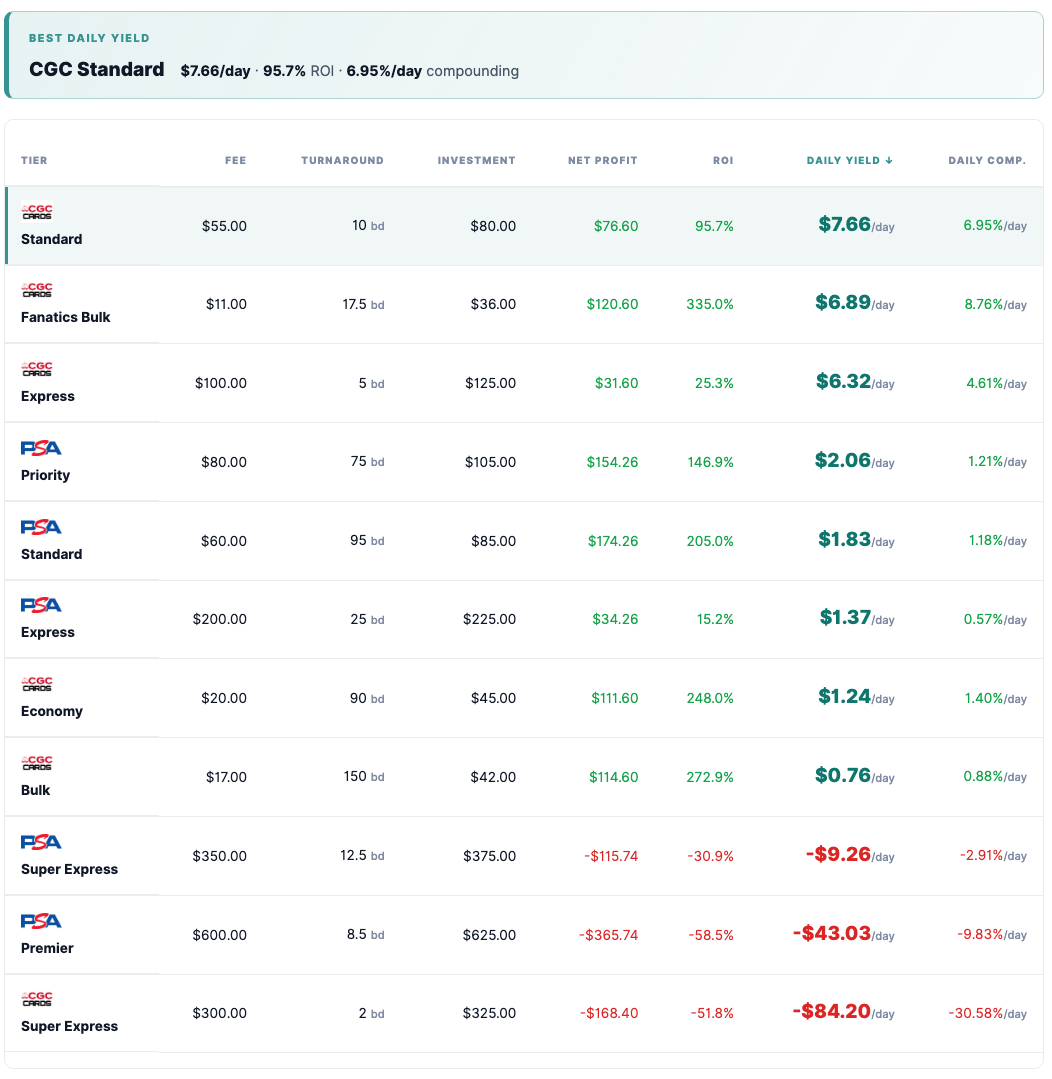
Surprisingly, perhaps (it was to me), the top three most profitable tiers to grade this card with are all CGC levels. CGC standard yields about $7.66/day (6.95% daily), Fanatics Bulk yields $6.89, CGC Express yields $6.32 and PSA Priority yields $2.06.
It’s not because they’re the cheapest. In fact, the cheapest CGC tier is actually the second best play from a daily yield perspective, and CGC Express provides a better daily yield than PSA Priority and Standard despite those tiers being cheaper, and the PSA slab value being higher. The initial cost to grade paired with turnaround time makes a massive difference.
Ok. But Pristine’s are far from a given (and undervalued, but that’s another story altogether), so let’s compare to the CGC 10 and see how that plays out.
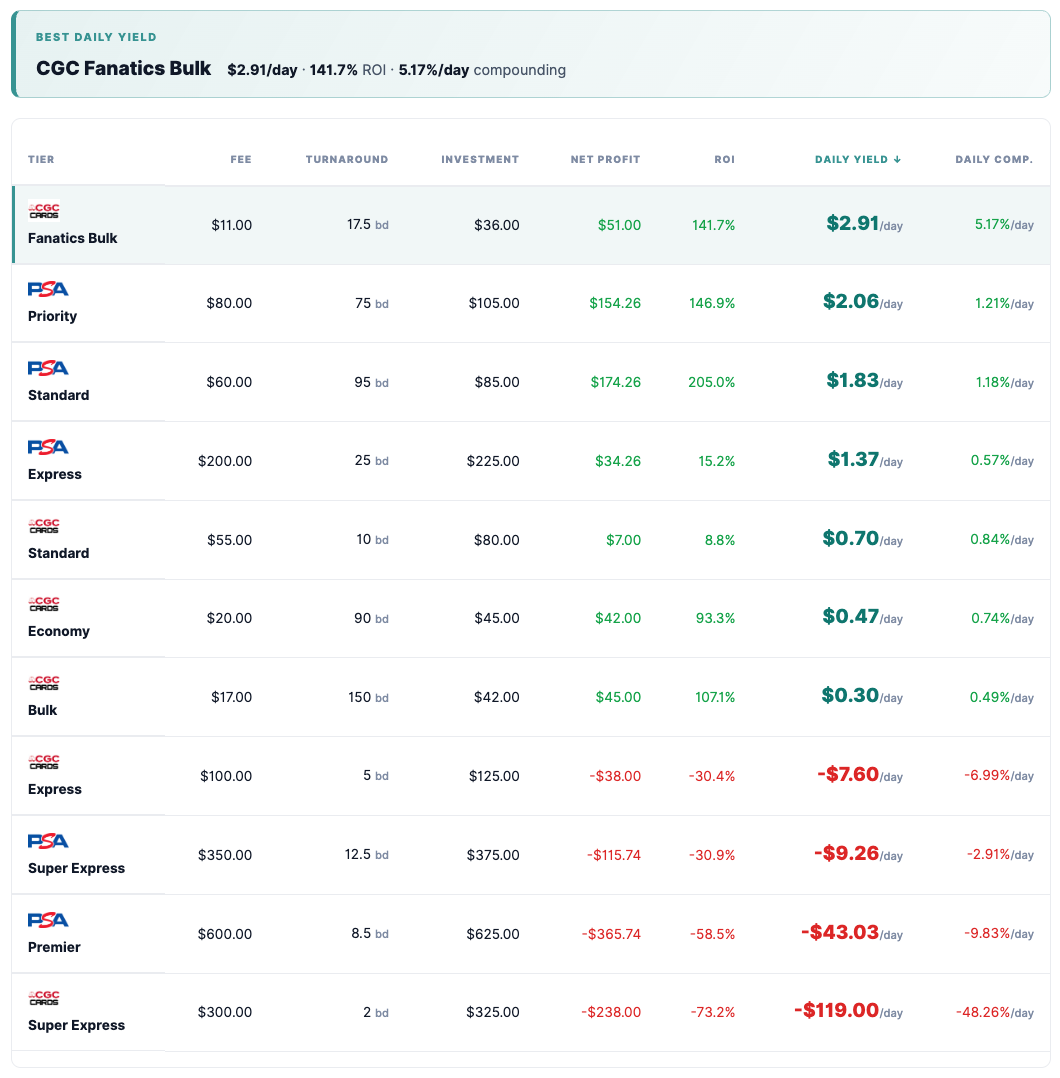
CGC’s bulk level through Fanatics Collect (a cheat-code for low-end slabs) wins again, but the gap is far less severe. PSA’s Priority and Standard Tiers are both within striking distance and if you believe you can move a PSA 10 easier than a CGC 10 (probably true), you can easily make the case to grade with PSA (if you are assuming a CGC Pristine is out of reach).
Bowman Crystalized Victor Wembanyama
Let’s look at one a bit more high-end: 2025 Bowman Chrome Crystalized Victor Wembanyama.
One sold raw yesterday for $2,345. The last PSA 10 did $4,000. There are no CGC sales that I can see, so we’re going to ignore that as a grading route altogether.
Now at a $4,000 value in a 10, technically if you submit at any level below a Super Express, you’re probably going to get hit with an upcharge up a level anyway, but it kind of doesn’t matter because from a daily yield perspective, that’s where you want to be.
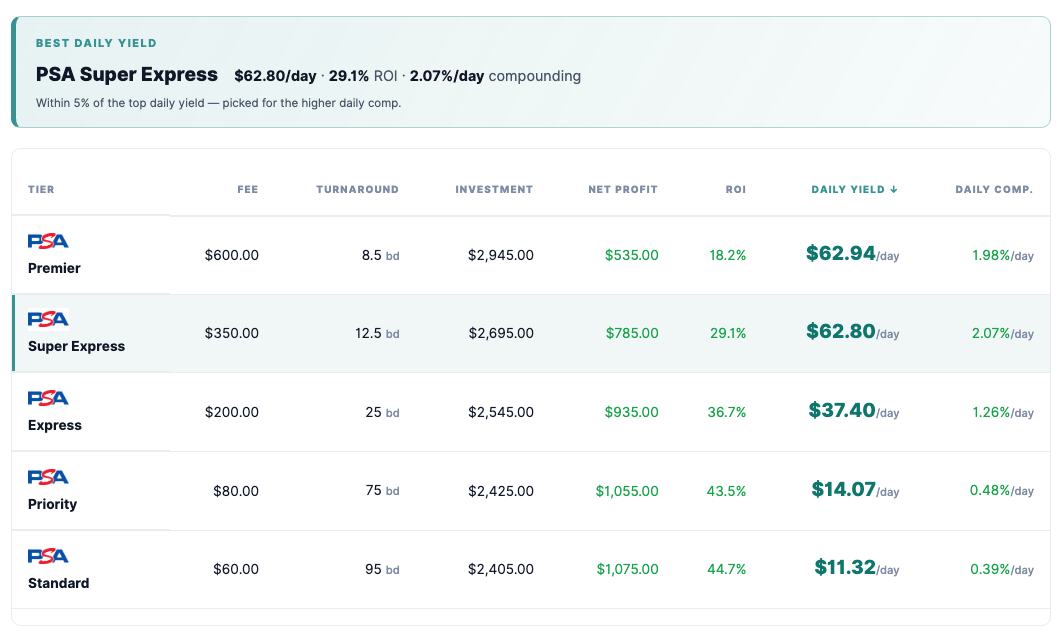
For this card, there’s a very clear gap between grading at the Premier and Super Express levels and everything else. The longer turnaround times at lower tiers would decimate the daily yield.
In this case, you could go with either Premier or Super Express as they’re virtually identical for daily yield. However, because you have a little less capital invested, the daily compounding rate is a hair higher (and the risk of not gemming a bit lower) with the Super Express level so that’s probably your best bet unless you think the 4 business day gap is enough for comps to drop significantly.
2025 Prizm White Disco Jaxson Dart
This is exactly they kind of card I would have loved to shove in a Value or Value Bulk order before those got shut-down, so let’s look at it through the lens of existing options.
Raw card last sold for $32. PSA 10 does $325. CGC 10 last did $94 and there are no CGC pristines.
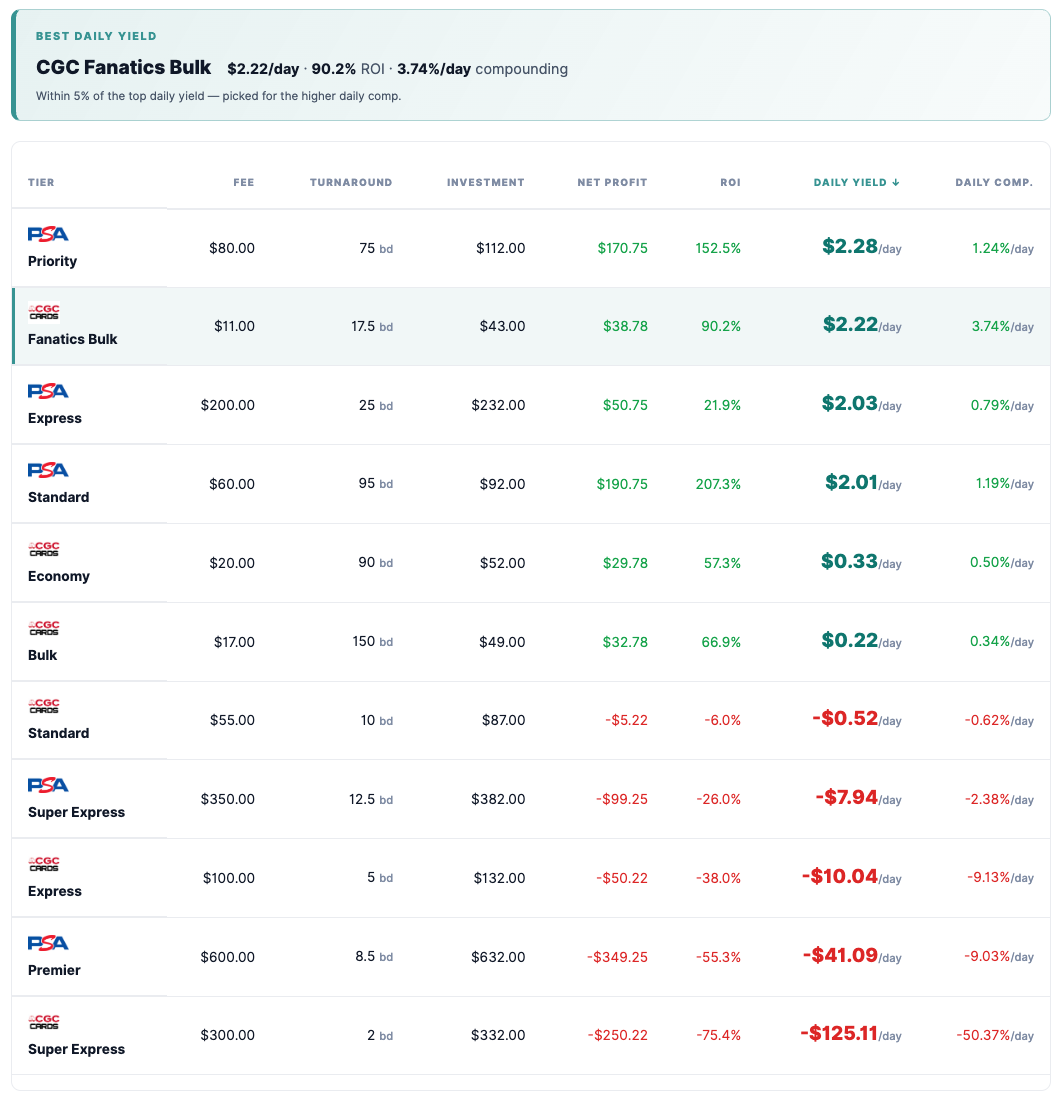
For this one, your best bet is either to pay up for PSA’s $80/card Priority tier, or go the cheap route with CGC’s bulk option through Fanatics at $11/card—the daily yield is virtually identical, though the compounding daily rate is significantly higher grading with CGC through Fanatics. This is one of those “use your best judgement” calls—if you think you can move the PSA 10 significantly quicker than the CGC 10, then it likely makes sense to go that route.
ROI isn’t everything
We could, of course, explore countless other scenarios, but that’s the point of making this an easily accessible online tool: to let you play and experiment a little bit. But I think even just a couple examples here demonstrate the value of looking beyond ROI and considering what that daily yield looks like.
Again, it’s a simple metric, but one that points you towards the value that you get in moving a card through that grading process quicker (so that you can sell it quicker, so that you can compound your profits and move on to the next play).
Good to see this written up. Yours is prospective — expected profit against grading cost and turnaround, run before you submit, to pick the tier. I do something adjacent but retrospective: realised profit per day across the full hold from purchase to exit, calculated at the point of sale. Been running it for several years. One picks the play, the other scores it.
Do you ever check your prospective estimates against how those submissions actually turned out?
Great stuff here, thanks for sharing. Lately I'm chasing the biggest return without thinking about the time invested in it, and this was a good reminder to slow down and look at the whole picture.